
The Serbian real estate market faces an “indecisive boom.” In early 2025, sellers are seeking higher margins, with asking prices up 5-10% in Q1, while buyers are cautious amid uncertain conditions. This buyer caution is driven by a mix of economic headwinds, such as inflationary pressures and fluctuating interest rates, as well as regulatory changes and ongoing regional geopolitical tensions. Belgrade set new average price records in March, but these figures only reveal part of the market story.
To find real alpha, investors must look past sticker price to negotiation gaps, resale dynamics, and new infrastructure on the city’s edge. Success in 2025–2026 means shifting from speculation to data-driven, income-focused strategies. As a concrete next step, investors can start by tracking closing prices versus initial listings across target neighbourhoods, seeking locations where transaction gaps currently favour buyers.
For example, focus on small, high-yield studio apartments in up-and-coming periphery districts with improving transport links, analyse rental demand using recent occupancy rates, and model projected cash flows after accounting for realistic sale price-to-value ratios. By blending price-negotiation insights with targeted rental-market data, investors can build a higher-certainty, income-oriented portfolio.
The Serbian Property Puzzle: 5 Impactful Takeaways from the 2025-2026 Real Estate Surge
Takeaway 1: The “5% Buffer”—Why Asking Prices Aren’t Absolute
Sophisticated buyers should note the typical 5% difference between listings and final sale prices. Sellers expect negotiation, so investors should rarely accept the initial price online.
Neighbourhood liquidity differs. While a 5% gap is common market-wide, in Vračar—a prime area with scarce renovated apartments—final sale prices align closely with initial asks.
“In Belgrade in 2026, the estimated gap between listing prices and final sale prices is around 5%, meaning buyers typically pay about 5% less than the initial asking price.” — Investropa.
Takeaway 2: The Resale Paradox—Existing Homes are Outpacing New Builds
We see a surprising Resale Paradox: existing apartment prices rose 18% year-over-year, far outpacing the 7% growth in new construction. This highlights a sharp inventory shortage in established neighbourhoods, where buyers prioritise immediate move-in over waiting for new builds.
Strategists note that new builds cost 8% more than existing ones, a premium that reflects their enhanced features and long-term investment potential. This price difference signals the market’s recognition of added value, such as lower ongoing maintenance costs, improved energy efficiency, and full compliance with future EU regulations. These factors help protect property values and reduce ownership risk over time. Current yield spreads suggest that new builds are best suited for a buy-and-hold approach, offering both stability and future-proof returns.
Takeaway 3: The 1% Entry Point—A New Era for Young Buyers
Serbia’s loan subsidy program for professionals aged 20–35 reshapes access to housing by requiring only 1% down and a 3.5% fixed rate for 6 years, helping young buyers and mitigating market risks.
The broader market benefits as lenders face less risk; the state backs 40% of loans for 10 years. Together with lower EURIBOR, the subsidy boosts demand for entry-level homes, offsetting rising prices.
Takeaway 4: Income-minded investors should note another crucial factor shaping returns.
Studio apartments lead income-focused investing. They yield 6.64%, outperforming the city average of 6.29%, demonstrating that smaller, liquid units best capture rental demand. However, investors should assess the sustainability of these high yields. While strong demand continues to support returns, there are risks that could pressure future yields—including potential oversupply if new developments accelerate or if macroeconomic conditions reduce tenant demand. Careful monitoring of upcoming projects and rental vacancy rates will help investors protect cash flow and adjust strategies if market dynamics shift.
Belgrade Waterfront is the top choice for luxury capital gains, with yields of 5.5-7%. Its appeal lies in resilience, prestige, and premium amenities, outpacing traditional central areas.
“Over the past four years, apartment values in Belgrade Waterfront have risen by over 40%, with owners earning 5.5 to 7% annually from their property’s value.” — Houserz (Belgrade Waterfront Analysis)
Takeaway 5: The “Expo 2027” Effect—The Periphery is the New Centre
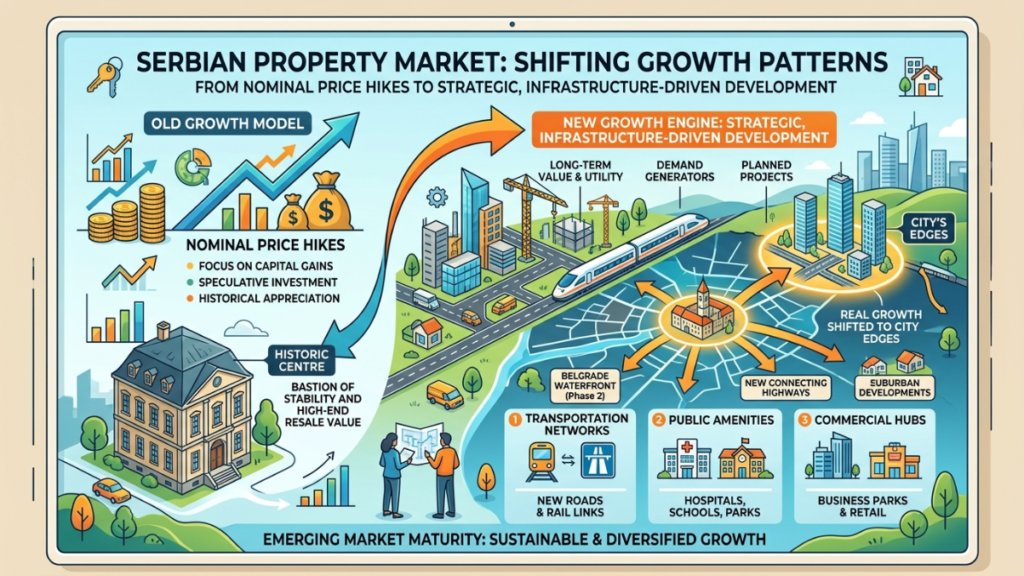
Belgrade’s development is shifting from the city centre to the periphery, driven by the “Expo 2027” effect. Areas from the new National Stadium to Block 46, supported by highway and metro projects, are now key for speculative investment. However, investors should be aware of potential risks in these peripheral zones. Project delays, slower-than-expected infrastructure rollouts, or fluctuating buyer demand could impact future returns. While the opportunities are significant, a careful assessment of both upside potential and these uncertainties will help produce balanced investment decisions.
This change brings a new living concept, with low-density, gated communities in places like Surčin and Jakovo replacing high-density cores. For investors, infrastructure projects indicate future value; areas like Makiš and Železnik are now strategic targets.
“Belgrade is slowly moving where the infrastructure leads. Most new constructions… are headed toward Expo, Surčin, Jakovo—where a completely different concept of living is already appearing.”
Nikola Seneši.
Conclusion: A Stabilising Market in Transition
The Serbian property market is maturing, shifting its growth engine from nominal price hikes to strategic, infrastructure-driven development. While the historic centre remains a bastion of stability and high-end resale value, the real growth has shifted to the city’s edges.
Looking to 2026, investors must decide: bet on a central historic apartment or a modern unit near new metro lines, as peripheral growth outpaces the core.
This article was prepared in collaboration with Gemini AI model by Google

Great post,Thanks for sharing