
The Strategic Framework for Serbian Immigration
Immigration to the Republic of Serbia is a comprehensive legal and life decision that goes beyond mere form filing. In the current regulatory landscape, a foreign national’s choice of initial entry basis acts as the “legal DNA” of their stay; it dictates the long-term viability of permanent residency and the eventual acquisition of citizenship. Strategic failure often occurs when applicants treat immigration as a checklist of transactions rather than a sophisticated legal maneuver.
For example, if an applicant enters Serbia on a student visa, time spent studying may not count fully toward permanent residency, delaying their eventual path to citizenship. Similarly, if someone selects property ownership as their entry basis but intends to work in Serbia, they may need to restart the process under a new legal ground, which can incur additional costs and administrative delays. These practical consequences highlight why careful strategy from the outset is essential.
Substance Over Form: The Principle of Legal Sustainability
The Serbian Ministry of Internal Affairs prioritises “substance over form.” A basis for immigration, whether it be real estate, employment, or entrepreneurship, must have a genuine purpose and real-life alignment to withstand rigorous administrative scrutiny. Legal sustainability, in this context, means that the chosen legal path for residence is not only valid at the time of application, but can also be maintained over the long term without contradicting the applicant’s real activities or intentions.
For example, a legally sustainable basis is one that will continue to support the applicant’s life plans and meet official requirements throughout the entire immigration lifecycle. It is the duty of Senior Counsel to evaluate “legal sustainability” beyond the surface level. We frequently find that a client’s desired basis (e.g., property ownership) must be corrected after legal analysis to a more secure or rapid path (e.g., employment) to ensure the client’s actual life plans are not compromised by administrative delays or rejections. “Technical Processing” is the enemy of “Legal Strategy.”
The Holistic Legal Ecosystem: The Connective Tissue
Serbian immigration law is the connective tissue binding multiple legal disciplines. Strategic success requires an integrated analysis of the following intersections:
- Labour Law: Employment-based residency requires prior legal structuring of labour contracts and strict adherence to labour regulations.
- Commercial Law: Entrepreneurial paths require company registration, preparation of corporate acts, and selection of appropriate activity codes.
- Property Law: Investment-based stays require meticulous legal verification of titles and sellers to ensure the asset provides a valid basis for stay.
- Family Law: Family migration involves resolving matters of personal status, parental consent, and the protection of the best interests of minor children.
- Tax Law: Long-term stay triggers tax residency, social security registration, and income tax implications that must be managed from day one.
Tier 1: Initial Entry—Selecting a Sustainable Legal Basis
Selecting the correct legal gateway is the most critical step in the roadmap. This decision determines the speed of integration and the stability of the applicant’s status under the Law on Foreigners.
Comparative Analysis of Entry Paths
Basis Initial Requirement Long-term Security Adaptation Requirements Right to Work
Employment: Job offer from a Serbian employer. High stability; linked to employer compliance. Social security and tax registration. Yes
Company Ownership Registration of Sole Proprietorship or LLC (DOO). High control; requires active business operations. Corporate acts; bookkeeping; 90-day activity start. Yes
Real Estate Ownership Purchase of residential property; title verification. Very secure for residency. Property tax; registration of residence. No (Requires separate permit)
Evaluating “The Digital Shift” and Compliance
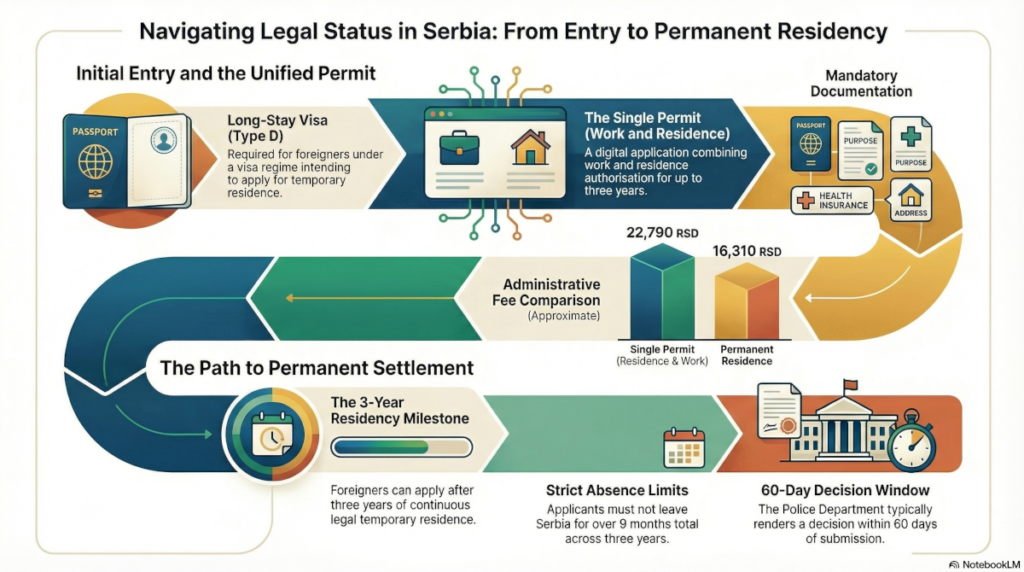
The introduction of the Unified Web Portal and electronic certificates has modernized the application lifecycle. The “Single Permit” now allows foreign nationals to live and work simultaneously under one administrative act. However, digitalisation demands higher precision; for Self-Employment, the law dictates that a foreigner must commence business activities within 90 days of obtaining the permit or risk cessation of rights.
Applicants using the Unified Web Portal can expect a streamlined step-by-step process: account creation and identity verification, digital submission of required documents, real-time tracking of application status, and receipt of electronic notifications for any additional information or approvals needed. The portal also enables secure payment of administrative fees and scheduling of appointments for biometric data collection. By understanding these digital process steps in advance, applicants can navigate the online system with greater confidence and avoid common pitfalls.
The Administrative Threshold
The client must understand that the administrative fee for the Unified Permit is 22,790 RSD (approx. €200). While EU citizens may eventually enjoy “Free Access” post-accession, the current regime demands immediate compliance from all foreign nationals.
Tier 2: The Unified Permit and Procedural Compliance
In the 2024–2025 regulatory environment, the Unified Permit is the primary vehicle for legal stay. It is not merely a permit but a rigorous compliance exercise.
The Application Lifecycle
The Ministry is mandated to decide on a duly submitted application within 15 days. This deadline only begins once all documentation is perfect. The lifecycle includes:
- Labour Market Test: For employment, the National Employment Service must verify that no Serbian citizen can fulfil the role.
- Biometric Data: Approved applicants must provide photographs and fingerprints for the issuance of the residence card.
Specialised Sub-Paths and Senior Counsel Insights
- Posted Workers & Intra-Company Transfers: These require a “Business-Technical Cooperation Agreement.” For Independent Professionals, a critical strategic detail often overlooked is the need for an NDA (Non-Disclosure Agreement) within the service contract to demonstrate professional substance.
- Documentation Ground Truth: All foreign documents must bear an Apostille and be accompanied by a translation from an authorised court translator. Standard “agency” translations are insufficient and lead to immediate rejection. Common document pitfalls that often delay or undermine the application process include submitting documents without an Apostille, relying on unofficial or uncertified translations, providing expired identification, or omitting essential documents. Even minor mistakes, such as unclear photocopies or incomplete forms, can trigger costly rejections. Applicants should carefully review all requirements and consult professional counsel to ensure that all documentation is accurate and fully compliant.
Tier 3: Transitioning to Permanent Residency (Stalno Nastanjenje)
Permanent Residency is the bridge to citizenship, offering a status close to naturalisation without time limits.
The Three-Year Threshold and the “9/6 Rule”
Standard eligibility requires 3 years of continuous residence. Continuity is defined by the Absence Rule: a foreigner must not be absent for more than 9 months total or 6 months continuously within that period.
- The Student Penalty: Time spent solely on schooling/studying results in zero eligibility for permanent residency. If the foreigner transitions to a basis such as employment, study time is then prorated to 50% (half-time) toward the 3-year requirement.
Procedural Realities
The deadline for the decision on permanent residency is 60 days. The 2026 guidelines require a checklist of:
- Proof of sufficient means of support and health insurance.
- Justification of the request (e.g., real estate or family reunification).
- Payment of the 16,310 RSD administrative fee.
Minor children of Serbian citizens or of Serbian origin (by descent) are exempt from the time condition, serving as a vital strategic tool for family migration.
Tier 4: The Final Objective—Serbian Citizenship
Citizenship provides full integration, voting rights, and a Serbian passport.
Primary Pathways to Naturalisation
- By Residence: Following the successful completion of the permanent residency phase.
- By Descent: For those with parents or ancestors of Serbian roots.
- By Marriage: Practical for those married to Serbian citizens, subject to specific duration and residence conditions.
Strategic Mechanism: Citizenship by Exception (Article 19)
Article 19 provides a highly discretionary naturalisation path for foreigners whose admission is of “special interest” to the Republic. This is not a “program” to be bought; it is a legal mechanism that requires the structured positioning of the applicant’s economic or cultural value to the state.
Administrative Realities (Article 9)
All applicants undergo a security risk assessment. Under Article 9, Para 3, an “unacceptable security risk” exists if the foreigner threatens the constitutional order, national security, or goods protected by international law. The Ministry of Internal Affairs holds final decision-making authority based on this assessment.
Risk Mitigation and Strategic Safeguards
The path to citizenship is a multi-year marathon. One procedural lapse can reset the clock or lead to deportation. To proactively safeguard your progress, applicants are strongly advised to maintain a detailed compliance checklist at every stage, tracking key deadlines, required documents, and legal obligations. Regular legal check-ins—whether through quarterly reviews with licensed counsel or periodic reassessment of personal circumstances—reduce the risk of oversights and ensure ongoing adherence to all evolving requirements. This disciplined approach is critical to avoid unintentional violations that could jeopardise long-term immigration goals.
Common Failure Points
Strategic failure is often rooted in:
- Incorrect Legal Basis: Applying under a basis that does not match actual daily activity (a top reason for rejection).
- Fictitious Addresses: Registering at an address where the foreigner does not truly reside.
- Unjustified Stay Interruptions: Violating the “9/6 rule” during the permanent residency build-up.
Security and Enforcement: The Duty to Inform
Under Article 8 of the Law on Foreigners, state authorities, legal entities, and individuals are obliged to immediately inform the Ministry of any foreigner residing illegally or any cessation of residence conditions. Monitoring is active and strict.
The Requirement for Professional Counsel for Immigration
The client must distinguish between a “relocation agency” and a Law Firm with licensed attorneys. We provide legal responsibility, individual case handling, and strategic support that an intermediary cannot. We align immigration with labour, tax, and corporate compliance to ensure your legal foundation in the Republic of Serbia is unshakeable. When selecting counsel, look beyond superficial marketing claims and request proof of bar membership, specific experience in Serbian immigration law, and a clear record of client representation before the Ministry. Consider whether the advisor can demonstrate a track record of holistic, long-term legal planning rather than simply transaction-based service. A qualified legal advisor should be transparent about fees, responsive to client queries, and able to coordinate with related disciplines such as tax and corporate law. These criteria will help ensure you partner with counsel who will protect your interests throughout the entire immigration process.
Final Summary: Establishing a solid, factually accurate legal foundation from day one is the only way to ensure a seamless transition from entry to Serbian citizenship.