
Quality of Health Services is probably the most important factor in choosing destination for retirees and digital nomads. What do we know about Health Services in Serbia?
In Serbia, the conversation around healthcare often centres on the traditional public system, a network of institutions available to all citizens. However, many residents and foreign nationals frequently overlook voluntary health insurance (VHI) until a crisis occurs or a bureaucratic deadline looms. This delay often stems from a misconception that private insurance is an unnecessary luxury or a redundant layer of protection. In reality, the Serbian healthcare landscape has evolved into a sophisticated dual system in which the private sector serves as a vital bridge to greater efficiency.
For expats and newcomers, securing private insurance typically involves several key steps: researching available policies, preparing required documents, applying for coverage, and obtaining official proof of insurance for residency or visa purposes. By knowing what to expect, individuals can navigate the process smoothly and avoid common pitfalls.
Beyond merely avoiding waiting lists, modern VHI packages offer unique legal, technological, and global benefits that are often hidden in plain sight. This article reveals five surprising realities of the Serbian private healthcare market that transform it from a simple safety net into a comprehensive lifestyle and legal tool.
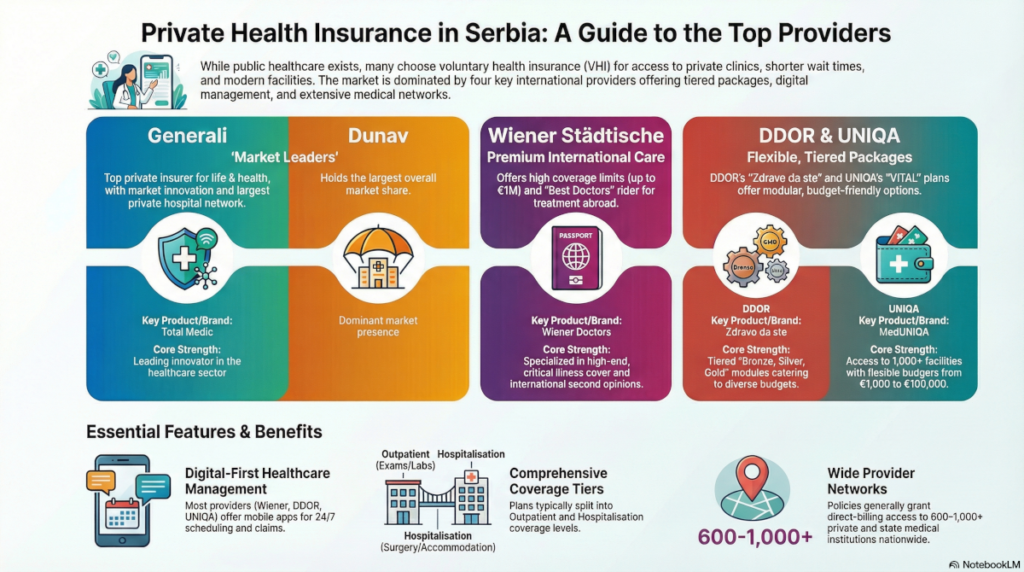
1. Global Care on a Local Budget
One of the most striking features of the Serbian VHI market is the ability to access elite international medical care through local policies. Products like “Wiener Doctors plus” demonstrate a significant democratisation of high-end medicine. For a monthly premium starting as low as €19, insured individuals can secure treatment in top European clinics for major procedures, including neurosurgery, heart surgery, and organ transplants.
However, a sophisticated navigator must understand the structure: “Wiener Doctors plus” is not a standalone medical policy but an add-on to a Life Insurance (Riziko) contract. Eligibility is generally open to both Serbian citizens and foreign residents, provided they can enter into a life insurance agreement. To add this coverage, applicants typically need to select a compatible life insurance policy, then request the “Wiener Doctors plus” package as an additional option during the application process.
Required documents usually include a valid ID or passport, proof of address in Serbia, and a completed health questionnaire. Furthermore, coverage is not instantaneous; the policy carries a 180-day waiting period (karenca) for these major treatments. Despite these conditions, the local-to-global bridge remains a powerful tool, ensuring that a resident in Serbia isn’t limited by domestic infrastructure when facing life-altering diagnoses.
“The coverage offers a 1,000,000 € annual limit and includes a second medical opinion from leading world centres, providing access to the best medical treatment in Europe for the most serious health challenges.”
2. The “Hidden” Wellness Menu (Quantum Medicine & Beyond)
Modern Serbian insurance packages have moved far beyond “emergency-only” coverage. Leading providers like DDOR (with the “Zdravo da ste” packages) and Wiener Städtische now include holistic, preventive services that were historically considered out-of-pocket expenses. This shift marks a significant evolution in the market toward “whole-person” health.
Surprising inclusions in these modern packages often include:
- Complementary Medicine: Coverage for acupuncture, homeopathy, and specifically quantum medicine.
- Mental Health Support: Specialised protection and counselling during crisis situations.
- Physical Therapy: Comprehensive rehabilitation and medical-technical aids.
- Preventative Check-ups: Annual systematic exams designed to catch issues before they require intensive intervention.
By integrating these services, insurers are moving from a reactive model to a proactive one, incentivising policyholders to maintain their health rather than just treating illness.
3. The Residency Requirement – It’s Not Just Optional
For the growing community of digital nomads and expats, private health insurance is often a non-negotiable legal foundation for their stay in Serbia. While public insurance is mandatory for employees of local companies, foreign nationals seeking residence permits without a local job contract must find an alternative.
To make the process clearer, here is a simplified step-by-step overview of how voluntary health insurance (VHI) fits into the Serbian residency permit application process:
1. Research and Choose a Suitable VHI Policy: Review available private health insurance options from licensed providers and select a policy that meets Serbian residency requirements.
2. Gather Required Documentation: Prepare personal documents, such as your valid passport, proof of Serbian address, and completed insurance application form.
3. Purchase and Obtain Proof of VHI: Finalise your insurance plan and request an official certificate or policy document confirming your coverage dates and benefits.
4. Submit with Residency Application: Include the proof of health insurance among your supporting documents when applying at the police office or the relevant immigration authority.
5. Await Processing: After submission, the authorities will review your health insurance certificate as part of the standard application checks before granting your residence permit.
By understanding these steps, applicants can feel more confident and organised as they navigate the legal requirements for living in Serbia.
VHI serves as a prerequisite for legal residency, acting as proof to the authorities that the individual will not become a financial burden on the state healthcare fund. For many, the insurance policy is the first document secured when establishing a new life in the country, effectively serving as the “legal foundation” of their stay.
“Expats without a job in Serbia must provide proof of private health insurance to obtain a residence permit.”
4. The 24/7 Digital Doctor in Your Pocket
Digital transformation is solving the relatable problem of medical bureaucracy and long wait times. Providers like DDOR and Wiener Städtische have launched dedicated mobile platforms—such as “moj.ddor” and “Wiener zdravlje”—that function as virtual medical assistants for scheduling and claims.
However, navigating the private sector requires an understanding of “participation” costs. While these apps offer claims on a click, many high-end policies (including those from Wiener) require a 20 per cent co-payment (učešće) when using top-tier clinics like Bel Medic or Medigroup.
For example, if a consultation costs 7,000 dinars at a partner private clinic, the policyholder would pay 1,400 dinars out of pocket, and the insurer would cover the rest. Similarly, a diagnostic test priced at 15,000 dinars would result in a 3,000 dinar co-payment. These figures can vary by clinic and service, but expats should budget for co-payments typically ranging from 1,000 to 10,000 dinars per visit or procedure, depending on the clinic and the complexity of care. This nuance is critical for financial planning, as it balances the convenience of elite private facilities with a shared cost model.
5. Tailor-Made Protection for Growing Families
The Serbian private sector provides a level of prenatal care that serves as a necessary upgrade when public facilities are crowded. High-tier packages, such as UNIQA’s “Vital” line or DDOR’s “Gold” package, specifically target gaps in traditional care by focusing on high-stakes diagnostics.
These policies cover essential tests that are often difficult to access quickly, including:
- Amniocentesis: Advanced genetic testing for high-risk pregnancies.
- Expert Ultrasounds: High-level diagnostic scans performed by specialists to monitor fetal development (often distinct from standard screenings).
- Private Delivery: Coverage for childbirth costs in private hospitals, ensuring a private and controlled environment.
“Health comes first, but prevention is paramount. Tailored packages ensure that from pregnancy to the first steps of a newborn, expert care is always accessible.”
The Forward-Looking Summary
Voluntary health insurance in Serbia has shifted from a luxury for the few to a strategic tool for the many. It is now a comprehensive lifestyle instrument used to manage legal status, physical well-being, and family security. As the market matures, we are seeing a “democratisation of care” in which international standards are becoming accessible within local budgets.
For the proactive individual, there is also the matter of Price Predictability. Current market analyses suggest that while competition is high, the absence of a unified service nomenclature across all clinics can lead to frequent price changes. Locking in a comprehensive policy now offers a layer of financial protection against the shifting costs of a developing private sector.
To make an informed choice, it is wise to systematically compare available policies before purchasing. Start by making a shortlist of reputable providers and collecting up-to-date brochures from their official websites or through direct inquiries. Gather details on key criteria such as coverage for major treatments, annual limits, co-payment requirements, waiting periods, and included extras, such as telemedicine or preventive care.
Pay special attention to exclusions and eligibility requirements, as these can vary. You might consider creating a side-by-side table to visualise what each provider offers in your specific circumstances. If possible, request a sample policy in English and ask a licensed agent for clarification on any unclear conditions. Checking reviews from other expats or consulting online forums can also offer practical insights into customer service and the ease of filing claims. By following these practical steps, expats can better match their actual needs with policy benefits and secure the best value for their healthcare investment.
Ultimately, navigating healthcare in Serbia involves a choice between the basic security of the public system and the agency offered by the private market. As you value your time and peace of mind, the private “upgrade” is no longer just an option—it is becoming the standard for those who prioritise rapid, high-quality, and global-standard medical support.